Why Businesses Use Local Virtual Numbers in Other Countries
9 min read Virtual numbers let businesses pick up calls in Berlin from a Tokyo line. Here is how companies use them to look local, dodge telecom rules, and skip the cost of a foreign office. May 12, 2026 12:29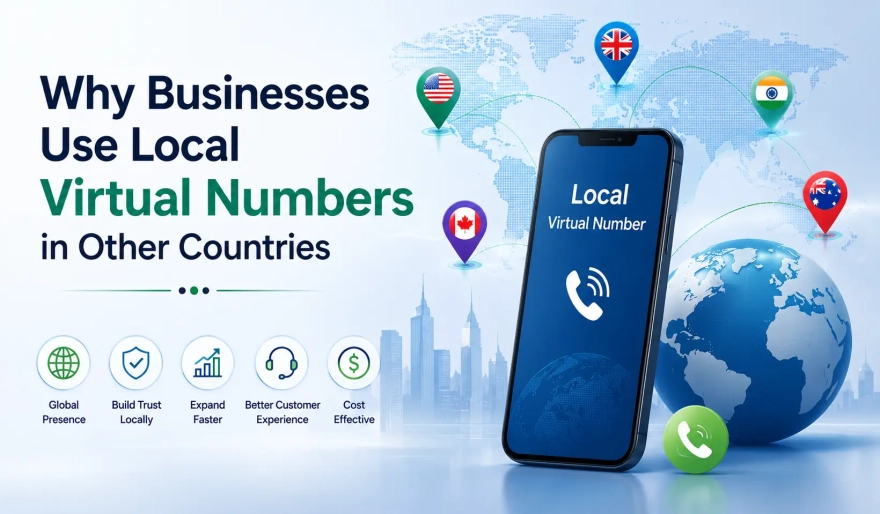
A company in Berlin picks up a phone call from Tokyo. The caller sees a Japanese number on their screen. They have no idea the person answering sits in a coworking space 9,000 kilometers away, drinking oat milk coffee and wearing slippers. That disconnect between perception and reality is the entire point of local virtual numbers – and it works.
Local virtual numbers route calls and SMS through the internet while displaying a country-specific caller ID. No physical SIM, no office abroad, no local telecom contract. A service like GetTempNumber hands you a number in whatever country you need, and your phone rings wherever you actually are.
Regulatory Headaches Disappear
Telecom rules vary wildly across countries. The EU has caller ID requirements. India has strict SMS sending rules. Brazil mandates specific number formats. Australia has its own do-not-call regime.
A business calling Brazilian customers from a German number is not just annoying to the customer – it might actually violate Brazilian telecom regulations. A registered local virtual number solves the compliance problem without needing a Brazilian subsidiary or a lawyer in São Paulo.
The regulatory boxes a local number checks:
valid caller ID matching the destination country;
compliance with local do-not-call registries;
SMS origination rules satisfied for transactional messages;
data handling aligned with local privacy frameworks.
None of this is glamorous. All of it matters when a carrier blocks your messages or a regulator sends a letter.
The Cost Math is Absurd
Setting up a real phone line in a foreign country means contracts, hardware, installation fees, and monthly charges that add up fast. For a business testing whether anyone in Indonesia actually wants their product, spending $2,000 on telecom infrastructure before making a single sale is a bad bet. A virtual number costs a few dollars. Cancel anytime. No hardware to return, no contract to break, no termination fee.
Who Actually Uses These Things
The same problem keeps showing up across industries: a business wants to look local in a market where it has no office. Virtual numbers handle that, just in slightly different ways depending on the use case.
Take e-commerce. A French shopper lands on the contact page and sees a French number. A German shopper sees a German one. Both calls route to the same support agent, but the caller never knows that. The local prefix removes the hesitation people feel about dialing abroad. Below are the patterns showing up most often in 2026.
The online shops have one phone number per nation, all directed to the same staff.
The SaaS apps can send alerts and verification codes through local numbers to avoid carrier filtering.
The marketing department gets each promotion its unique number to know which poster or billboard brought about the call.
Freelancers and consultancies can get a +44 or +1 number without a UK or US office and just by using their laptops.
A marketing example makes the campaign-tracking case obvious. A billboard in Lagos gets one number. A Google ad in Jakarta gets another. Both numbers feed back into the same dashboard, and the team can see at the end of the week which campaign drove more inbound calls without guessing.
For freelancers and small teams, the math is even simpler. Someone working from Lisbon with UK clients picks up a +44 number on a laptop. The client on the other end hears a clean answer and does not care where the line lives. That kind of setup used to require an office or a dedicated phone. Now it requires an account login.
Why Virtual Numbers Beat Legacy Telecom on Speed
The flexibility gap between virtual numbers and old telecom setups becomes obvious the moment a team tries to move fast. With virtual numbers, lines in three new countries can be live by Wednesday if the request comes in on Monday. Killing a line in a market that underperformed takes one click and costs nothing. Adding five more lines to a market that suddenly grew happens before the end of the morning.
The same workload at a legacy provider plays out differently. Sales sends paperwork. The technical team books a setup window. Billing asks about the next quarter. By the time the contract closes, the campaign that prompted the request has often lost its moment.
The practical differences between virtual numbers and traditional phone setups come down to a handful of operational realities.
Lines go live in minutes, without long-term contracts.
Unused numbers can be canceled at any time, without penalties or billing-cycle delays.
Capacity scales up or down with campaign needs, with no hardware investment.
Everything runs from a single dashboard, with no sales calls required.
Numbers from multiple countries land in the same system with combined reporting.
This setup fits the way teams operate in 2026. Experiments run quickly, weak channels get dropped early, and strong ones get more budget within days instead of quarters. Sales teams stop waiting on IT for provisioning. Marketing teams stop walking account managers through every new project before it can start.
For small and mid-sized companies, the difference goes beyond convenience. Markets in 2026 do not slow down for anyone, and whichever team opens a new channel first tends to capture the early customers. Virtual numbers are a part of the toolkit that makes opening that channel fast enough to actually matter.
User Comments (0)
Popular Apps